
Tappan Wilder’s 2022 Afterward To The Cabala
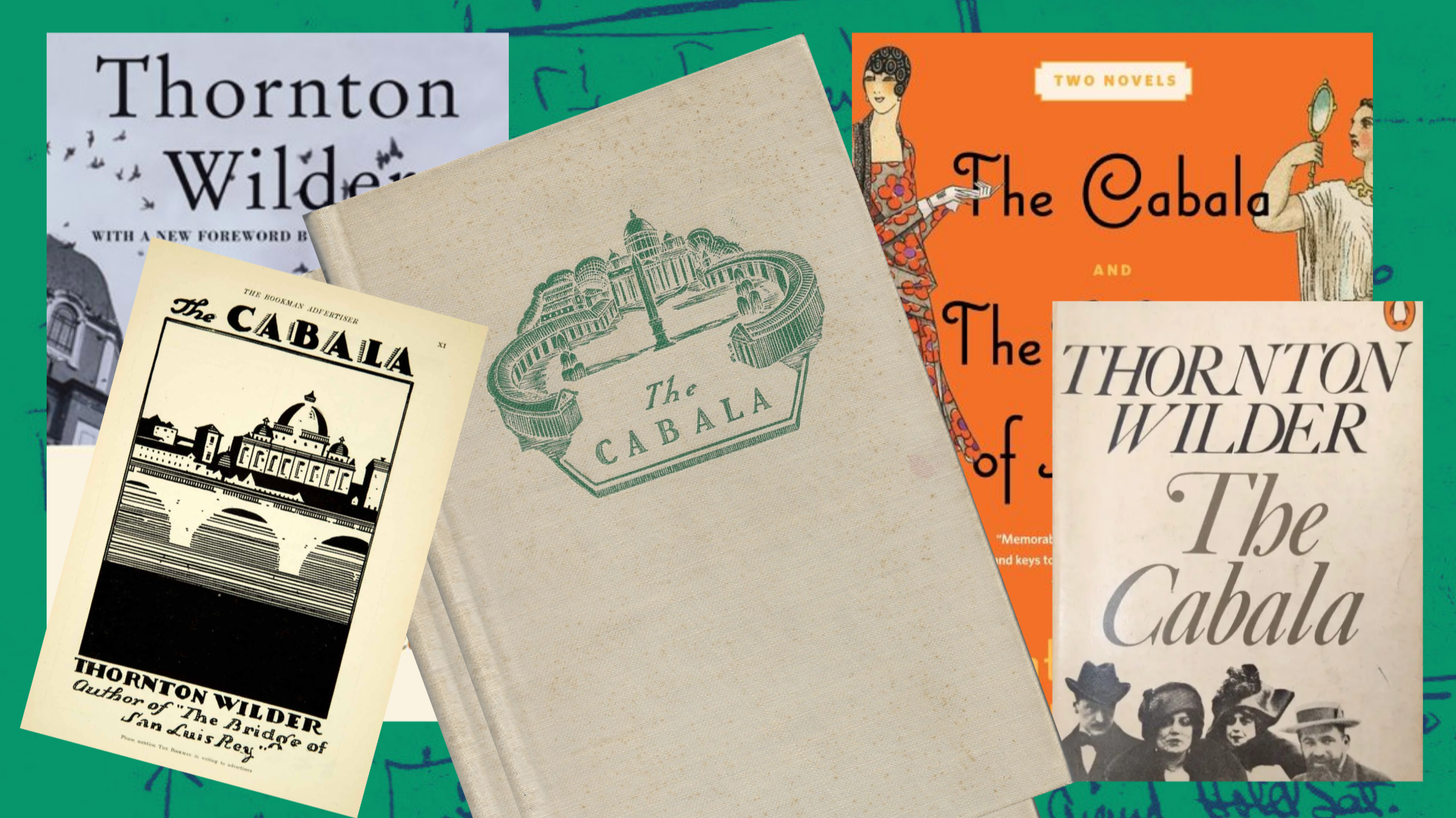
Afterword To THE CABALA By TAPPAN WILDER
THE CABALA
I began writing my first novel [The Cabala] thirty-one years ago—in a small hotel on the left bank of the Seine, where so many American novels have been begun.
— Thornton Wilder on receiving the Gold Medal for Fiction from the American Academy of Arts and Letters, April 1952
Mr. Thornton Wilder’s publishers, Albert and Charles Boni, must have been in a fine frenzy of dismay and delight as the successive chunks of The Cabala made their tardy appearances in the office.
— Herbert Gorman, Introduction to the Modern Library edition of The Cabala, #155, May 1929
LATE TO HIS PARTY
Deeply impressed with his highly polished literary style, the recently established New York publishing house of Albert & Charles Boni, Inc., published Thornton Wilder’s novel The Cabala on April 21, 1926. The first printing was reliably reported at the time to have been 3,250 copies. Befitting a debut book, the dust jacket was unadorned with outside testimonials; the publisher’s endorsement on the back read:
It is seldom that publishers find an author whom they may recommend unreservedly. The biting irony and exquisite phrasing in which this young author couches his intimate story of the high aristocratic group in Rome today seems to us of the highest order. It is a book to delight every admirer of the exotic in writing.
It is a time-honored obligation of friends to come to the aid of an author, especially on the occasion of the first book. Whatever lay ahead, Boni had good reasons for believing that future printings of the dust jacket could contain quotable language from the author’s notable literary friends and admirers. Boni would not be disappointed. It is no surprise that a Yale tie was the common denominator for this anticipated publicity; Wilder, who had received his undergraduate degree there in 1920, had lit up the sky as an acclaimed prize- winning student author.
What amounted to a Wilder Yale alumni booster club included two of the author’s former teachers: William Lyon Phelps, perhaps the best-known popular lecturer on literature in the country during this era; and Henry Seidel Canby, who, in 1924, had traded the classroom for the New York literary scene where he became a founder and editor of The Saturday Review of Literature. The club also included such classmates and close friends as John Farrar, editor of The Bookman, an important literary monthly; Briton Hadden and Henry Luce, who cofounded Time magazine in 1923, and had garnered a circulation of more than 200,000 readers by 1926; and Norman Fitts, book reviewer for the influential Boston Evening Transcript. During his senior year in Yale College in 1919, Fitts had established a recognized “little magazine,” S.4.N., on whose editorial board Wilder served and in which he published occasionally until it closed down in 1924.
Wilder referred to his fans collectively as “Gossip Fair,” noting that they had been waiting for his literary debut for years. Gossip Fair had grounds for its opinion; so stunning had been Thornton Wilder’s undergraduate literary record that although he was only twenty-nine when The Cabala was published, he was judged “unacceptably late to his own party.” While aware of this view it appears never to have represented a burden for Wilder. As he was frantically pulling together the manuscript of his first book in June 1925, he wrote to his close friend Les Glenn, “My emergence is long delayed, dear Les, but irresistible!” To his brother, Amos, he assigned a hard number: “Excuse me saying that I waited six years beyond the time when Gossip Fair assigned me a debut.”
A RATHER SOPHISTICATED LITERARY CURIOSITY
Books from Yale men ornament the spring lists with persistence. Thornton Wilder, whose undergraduate days were marked with brilliance, has written what promises to be a rather sophisticated literary curiosity in “Cabala,” which will be his first published book
— The Bookman, April 1926
Talent and notoriety aside, how did Boni view the marketplace prospects for a novel The Bookman hailed “a rather sophisticated literary curiosity”? The answer is no surprise. Despite his publishers’ enthusiasm about Wilder’s style and faith that friends in high places would work hard for the book, Boni saw its new author’s appeal limited to a highly cultivated readership. In short, they assumed that The Cabala would not be a bestseller.
The author’s background reflected the esoteric. The biographical note on the dust jacket offered this description:
THORNTON WILDER was born on April 17, 1897, Madison, Wisconsin. He spent his early years in China where his father was Consul General, and later prepared for college in California. He was graduated from Yale in 1920, after which he spent two years in Rome. The Cabala grew out of that experience of these two years. After this he taught at Lawrenceville and is now devoting his time to studying and writing at Princeton Graduate School.
For the record, Wilder spent a total of two years in China as a boy and only eight months, not two years, in Rome, after college. But give or take a publisher’s exaggeration, there did appear to be more than a tincture of the exotic about his life to go along with hiseducational credentials.
One fact in this biography was accurate: The Cabala was inspired by his stay in Rome after Yale, as reflected in Wilder’s dedication of the book: “To my friends at the American Academy in Rome, 1920–1921.” Although neither his formal training nor vocational interests qualified him for full admission to one of the American Academy’s two established programs, his credentials were strong enough for him to obtain a self-paid place, thanks to the Academy’s lean times, and empty beds following World War I. This allowed him to participate in the life of an institution with a notable address on a notable hill in Rome to the degree that he wished. Many years after, he recalled his position and the freedom it offered:
The students on the Janiculum Hill were divided into two disparate and even inimical groups. There were on the one hand the Prix de Rome men who had been carefully se-lected for great promise in architecture, painting and sculpture, and music. In my time there were no women among the artists. And there were the classical students, men and women, also selected from among scores of applicants to work in archeology, Latin literature, and Roman history. With very few exceptions these two groups kept to themselves, sat at meals themselves, and enjoyed parties and excursions by themselves. The two groups were often designated as “geniuses” and the “grinds.”
I was neither a prize man nor a qualified classical scholar. I was a fish who swam in both waters.
And we know from letters to friends and home, Wilder not only swam with both geniuses and grinds, but also explored the city on his own, sat at many a non-Academy table, and attended many a party. To his sister Isabel, he wrote in the spring of 1921:
I seem to be living in Italy for the sole purpose of receiving the confidences of ladies in distress. The details of woe, broken engagements, insult and injury I’ve had to listen to from grand dame to servant-girl would freeze your spine. There’s something in the air over here: everyone is unhappily in love every minute of their lives, and only too glad to find a sympathetic eye and ear.
Wilder, pen always at hand, left Rome for Paris, where he stayed for several months in the spring and summer of 1921. Here, in a hotel on the left bank, followed by a cold-water flat on the Rue St. Jacques, Wilder began a work of prose about a group of fascinating and very unhappy individuals in Rome, including a prince of the Church. The writing did not go easily. As he wrote his mother, “I struggle over the descriptive passages in Romans and despair of ever writing prose.”
Struggle he did. Wilder worked on his “Romans” intermittently from September 1921 to mid-November 1925, a period encompassing his four years as a French teacher and assistant dormitory master at the Lawrenceville School, a private boarding school for boys in New Jersey, and his first semester of graduate study in French Literature at Princeton University. During the Lawrenceville period, a major contributing influence on his work was his reading in classical French literature, anchored by such authors as La Bruyère and Saint-Simon, coupled with a passionate interest in contemporary authors, particularly Marcel Proust. The membership of Wilder’s “cabala” were, as he would often say, inventions of his imagination—an imagination fueled by his literary record, tested against the sights, people, and landmarks of post–World War I Rome in fact and memory.
STOP AND GO
The making of the manuscript breaks down into two periods—before and after the Boni firm opened the door to Wilder on March 3, 1925. In the earlier period, we encounter a writer feeling little pressure to complete his “Roman Memoirs” (as he identified them) and endlessly writing and rewriting. Moreover, although he appears to have had a conception of some larger whole, it is clear that his drive for compression of language and theatrical characterization meant that his work-in-progress marched forward as discreet short stories, or “portraits,” as he also referred to them.
If Gossip Fair did not understand Wilder’s delay with destiny, it is adequately explained by his profession as a resident teacher and dormitory master in a boy’s boarding school, a job entailing endless hours that also spilled over into summer tutoring. Still, in addition to many “stolen hours” reading in the nearby Princeton University Library, there were free nights, off-duty weekends, pieces of long vacations, and, starting in 1924, a month-long writing residency at the MacDowell Colony, an artists’ retreat in Peterborough, New Hampshire. His progress on fiction was further complicated by his competing passion for drama and attending theater. Stories of Wilder working on his “Roman Memoirs” in Davis House (the Lawrenceville student dormitory where he lived) remain part of that school’s lore. During this time, however, the would-be novelist haunted theaters in New York, Philadelphia, and Trenton, all located within two hours of the school.
It came down to this: until 1924, Wilder was in no particular hurry to publish. He loved teaching and the steady income it provided, as well as the supportive community that Lawrenceville represented—a community that meant a great deal to a young man raised all over the world. What would someday become The Cabala moved forward in a stop-and-go fashion. The following excerpt from letters to his family in 1922 suggests his reading and writing style in this period:
You will grin to hear that I have taken up again my imaginary memoirs of a year in Rome. . . . The memoirs are made up of formal portraits . . . interspersed with every now and then a complete little “conte” dropped into [the] current, told by some character, like Canterbury pilgrims. I have been reading the endless tomes of Saint- Simon.
— April 11, 1922, from Lawrenceville School
Just as soon as I get a fair copy made of BOOK I, I look it over and with my blue pencil start indicating alterations; within an hour the whole script is unsightly. My only consolation is that every touch has been an improvement. This has happened five times already and it is about time the thing were perfect, but I still find shell holes. . . .
— July 20, 1922, from Newport, Rhode Island
Well, a good deal more has been written and almost the whole projected. I am doing a vast amount of reading (I am never able to see afterwards where I found the time to do yesterday’s, or where I shall find it tomorrow; but the inveterate reader somehow contrives—in spite of the fact that I am conspicuously faithful in my school duties). For instance my second book is an elaborate satire on the French Royalist party.
— November 5, 1922, from Lawrenceville School
PICTURE YOURSELF A STAGE
The year 1924 was a turning point in Wilder’s development as an artist. With some money in his pocket from teaching and tutoring, and excitement about being associated with the MacDowell Colony and the recently established Laboratory Theatre in New York, Wilder found himself dreaming of publishing more than just short pieces in the period’s “little magazines.” In 1923, at S.4.N., Wilder’s Yale friend Norman Fitts launched a book publishing subsidiary. As best as can be determined from the evidence, only Fitts’s serious illness, which forced him to close S.4.N. late in 1924, kept Wilder from making his major publishing debut with the third volume in this new venture. The book was to contain ten of his short-short plays (or “three-minute playlets,” as they were known); several other short pieces of fiction; and “Five Roman Portraits.” Judging from their titles, these portraits represented most of the subject matter later found in The Cabala. And what title did Wilder propose for this volume? His choice honored his allegiance to the dramatic side of his art: Picture to Yourself a Stage.
The failure of the S.4.N. venture concluded the first chapter in The Cabala’s prehistory. But no sooner had that door closed than another opened. A Yale tie again figured in the story. In the summer of 1924, following an apprenticeship of two years with Alfred A. Knopf, Wilder’s Yale classmate Lewis Saunders Baer moved to the position of secretary-treasurer at the publishing firm of Albert & Charles Boni, Inc. Here he learned, no doubt through the Yale grapevine, that his classmate Thornton Wilder might have a manuscript looking for a publisher. Soon after, what appears to have been a version of Book One of The Cabala changed hands. After weeks of silence, on March 3, 1925, Wilder received the letter that would-be authors dream of receiving: “I am more than delighted to report,” wrote Baer, “that we are all crazy about it. Albert Boni feels so strongly about your style that he is very anxious to see more.” With shades of Gossip Fair in the background, Baer went on:
I knew this would be the result of our reading, because I remember so distinctly how impressed I was at your stories in college. I do hope we will be able to get together a book which can mean the start of your career as an author, in print I mean. No one would be happier than I.
Although Albert & Charles Boni was a new publishing house, its founding brothers were experienced, inventive book men. Albert Boni was a well-known figure in the trade through his role as a founder of the Boni & Liveright Publishing Company and the Modern Library, both in 1917. His brother Charles cofounded Little Leather Library, a publishing venture that succeeded in targeting a market for a series of classic works of literature, and was the predecessor to the Book-of-the-Month Club. In 1923, the brothers joined forces. Albert, who had also played a role in establishing the Theater Guild, was particularly interested in modern European letters. In 1920 he had edited a popular edition of French verse, and he later saw to it that the work of such authors as Proust and Colette were represented among the early titles of his new publishing venture. Given his taste in fiction, it is no surprise that Albert Boni was attracted to Wilder’s prose and “anxious to see more.”
Because few early drafts of The Cabala survived, we know all too little about how the five Roman Portraits destined for Picture to Yourself a Stage evolved into a novel called The Cabala. What we do know is that over an eight-month period beginning in March 1925 and ending in late November, Wilder revised existing copy once more and added new material, including Book Five, “The Dusk of the Gods.” The title The Cabala dates from this period, at the end of which, in November, Wilder finally received a book contract. Why did the Boni firm withhold this document until the last minute? The answer has to be that until they were confident they had enough material to make a book from an author practicing compression with an all but religious fervor, the Boni brothers did not wish to offer a contract.
The history of The Cabala as a legal entity began on November 19, 1925, the day Wilder signed a book contract for a novel identified in Article 1 as The Caballa, as it was often spelled at the time. As noted, the transformation of a series of portraits into a novel had taken place during his last semester of teaching at Lawrenceville, a summer job, and much of the first semester of his year of graduate studies at Princeton. Wilder burned the candle at both ends to accomplish his mission, as suggested by these excerpts from letters to his mother:
I am still on the Alix d’Espoli story. I hope it will move people as it does me. I sit at the foot of my bed writing until I am— prevented.
— June 10, 1925, Lawrenceville School
I am sending you Book Four today. It is terminated but not finished. . . . “It will have to do.” I never thought I should have to say that of anything of mine, but I am frantic to finish this five-year thing and get back to my plays. . . . But first I must finish the Epilogue to the Memoirs.
— November 2, 1925, Graduate College, Princeton University
THE DEBUT OF AN AMERICAN STYLIST
The Cabala was published on April 20, 1926, by Boni in the United States, and in October of the same year in England by Longmans, Green & Co., Ltd., using a Longmans cover and Boni-supplied pages. Any fair reporting on the book’s reception must treat the two editions as one.
Reviewers were almost uniformly enthusiastic about the novel. While the occasional notice pointed to elements of wisdom and insights about human nature in Wilder’s story, critics above all praised his style, a viewpoint expressed in the lordly New York Times that has followed the book ever since: “The appearance of Thornton Wilder’s Cabala marks the debut of a new American stylist.” That many others agreed, picking up on the novel’s satire, irony, wit, and epigrammatic style, is suggested by this collage of phrases from the dailies: “[The] prose is exceptionally beautiful; its texture has a rare consistency of distinctive weaving.” (New York Post Literary Review); “The writing is beautiful in the extreme.” (Sheffield, U.K., Independent); “It has the cool sparkling quality of a champagne cocktail.” (New York Tribune); “A remarkable maturity and sureness of its style.” (Yorkshire, U.K., Post); “To students of style it is well worth careful perusal.” (Portsmouth, U.K., Evening News)
Wilder’s friends from Gossip Fair joined the parade, as expected. William Lyon Phelps wrote in Scribner’s, “An exquisite work of art, written with beauty, grace and charm.” Time called The Cabala “one of the most delectable myths that ever issued from the hills of Rome.”
Something akin to a fanfare appears to have occurred when Wilder returned to the American Academy in Rome in late October 1926. As he wrote his family about the novel’s reception in this special place,
I went up [to] the Academy, had tea with the prizemen in my beloved halls, was taken home to dinner by the director and around the faculty for brief calls. The book has been read by all with a sort of scandalous delight. Even old Romans take it as the hot stuff from the secret circles.
Finally, as the good news rolled in, Wilder found himself compared favorably to a remarkable range of successful and popular authors of the period, among them James Branch Cabell, Walter Pater, George Moore, Carl Van Vechten, Anatole France, Norman Douglas, Elinor Wylie, Max Beerbohm, and Aldous Huxley.
While no novel is immune to negative press, what is unusual about The Cabala is how few outright knocks Wilder’s first book received. In England the august Times Literary Supplement put the American in his place by observing that “the book . . . has a certain deceptive brilliance, an aggravating air of ‘knowingness’ and familiarity with European culture that may have helped its American popularity.” When arrows arrived, they typically did so as comments on technical matters, such as Wilder’s choice to avoid quotation marks and the numerous typos in the first printing. One feature of the first printing of The Cabala, well known to book collectors, is the more than two dozen errors it contains, due to inadequate proofreading by the author and the apparent resetting of the book at the last minute to increase its page size. Dorothy Bacon Woolsey in the New Republic found the otherwise “excellent suggestive writing marred by inexcusable typographical errors, misspelling, total omission of words, and astonishing inaccuracies in punctuation.”
All in all, The Cabala enjoyed remarkable critical success. If its sales kept it from the bestseller status that other Wilder novels would achieve, the numbers were nonetheless impressive. It appeared that the market for the exotic was larger than anticipated. In its first year, Wilder’s first novel sold 5,357 copies in the United States, probably more than twice what Boni needed to sell to break even, and as many as another thousand in Great Britain. His debut may have been delayed, but from the beginning, it exceeded expectations, as suggested by the author’s happy words to his friend Les Glenn in September, six months after The Cabala’s initial appearance:
Our book is now well through the third printing. We thought it was intended for a restricted circle of reflective sophisticates but all sorts of people are reading it, understanding little, but driven on by the faintly snobbish feeling that it’s high- brow and “beautiful” and modern.
And the novel kept selling. By the eve of the appearance of Wilder’s second novel, The Bridge of San Luis Rey, in November 1927, sales of The Cabala totaled some seven thousand, and the book was in its fourth printing. Its strong reception naturally registered quickly on that sensitive barometer of literary fortunes, the dust jacket. By the summer of 1926, the book was festooned with no less than eight blurbs—four on the front and four on the back. Sales were strong enough for Boni to justify advertising the novel in Publishers Weekly and The Saturday Review of Literature. On the outside, no member of Gossip Fair was more active on the book’s behalf than John Farrar, editor of The Bookman. Besides an enthusiastic review (“a talent so authentic and so startling”) and several tidbit stories (among them that Wilder pronounced “Cabala” with the emphasis on the first syllable), Farrar highlighted the novel with the only triple star in a 1926 list of fifty recommended books for summer reading.
ALSO BY THORNTON WILDER
In the end, a first book can do an author no greater service than guaranteeing publication of the second. From the moment of The Cabala’s appearance, his publisher was urging Wilder on. Twenty months later, on November 3, 1927, The Bridge of San Luis Rey was published. There was nothing naked about the dust jacket this time: “AUTHOR OF THE CABALA,” appeared under the title, and the back of the jacket featured five Cabala blurbs under the header “ALSO BY THORNTON WILDER.” Although expecting to do better with The Bridge, Boni still viewed Wilder’s readership as limited, and guardedly published a first printing of 4,000 copies, 750 more than the first printing of The Cabala. “Once more,” read the dust jacket, “it may be prophesied that this book will stir the most sophisticated reader.”
The appearance of The Bridge of San Luis Rey did not stir the few; rather, it ignited one of the great explosions in American twentieth-century literary history. By 1929, more than 300,000 copies had been sold in the United States and England, the novel had been serialized in the Hearst newspaper chain, a film version had been released, and Wilder had received the 1928 Pulitzer Prize for fiction. In September 1930, in The Delineator, Professor William Lyon Phelps wrote of the impact on Boni, “[The Bridge] was accepted by the publishers because they thought so fine a book ought to be printed, but they had no belief in its success with the public, and they have not yet recovered from the shock.”
How did The Cabala weather this extraordinary success? Very well indeed. Seeking to understand the phenomenon of The Bridge, critics and readers turned back to Wilder’s first novel. This led to a fresh crop of thoughtful reviews, especially in England, where a new Longman’s Green originated edition of the novel appeared in March 1928. Thanks to the power of The Bridge, The Cabala’s Second Coming was capped by its publication as Number 155 in the Modern Library in May 1929. By then, total sales of The Cabala stood at nearly 19,000 copies in the United States alone, and negotiations were far advanced for the first foreign-language editions, of which there have been eleven through the years.
Because of its inevitable comparison with The Bridge of San Luis Rey, The Cabala has long been judged a succès d’estime. But even in its infancy, as this account suggests, the novel was something more than that. With an eye on its subsequent history, we cannot forget that besides its many foreign editions (fourth in number only to The Bridge, The Ides of March, and The Eighth Day), The Cabala has been in print almost continuously.
Wilder always reserved a special place in his artistic heart for his first novel. He even considered the idea of adding new chapters for it in 1940. In 1962 he read a selection from it as part of “An Evening with Thornton Wilder,” a gala event arranged at the State Department Auditorium by members of President John F. Kennedy’s cabinet. The author remained grateful to a tale marked, as he later put it with bemused affection, by a “frequent display of far-fetched information.” Finally, there is the author’s last and greatest compliment to his first book: Theophilus North, his final novel, published in 1973, two years before his death. In this story, an all-seeing young man moves in and out of the houses of the mighty and not so mighty in Newport, Rhode Island, in the summer of 1926, in much the same way Samuele visits palazzos in Rome in 1921. Theophilus North is Thornton Wilder’s American Cabala, the former his evening light, the latter his morning.